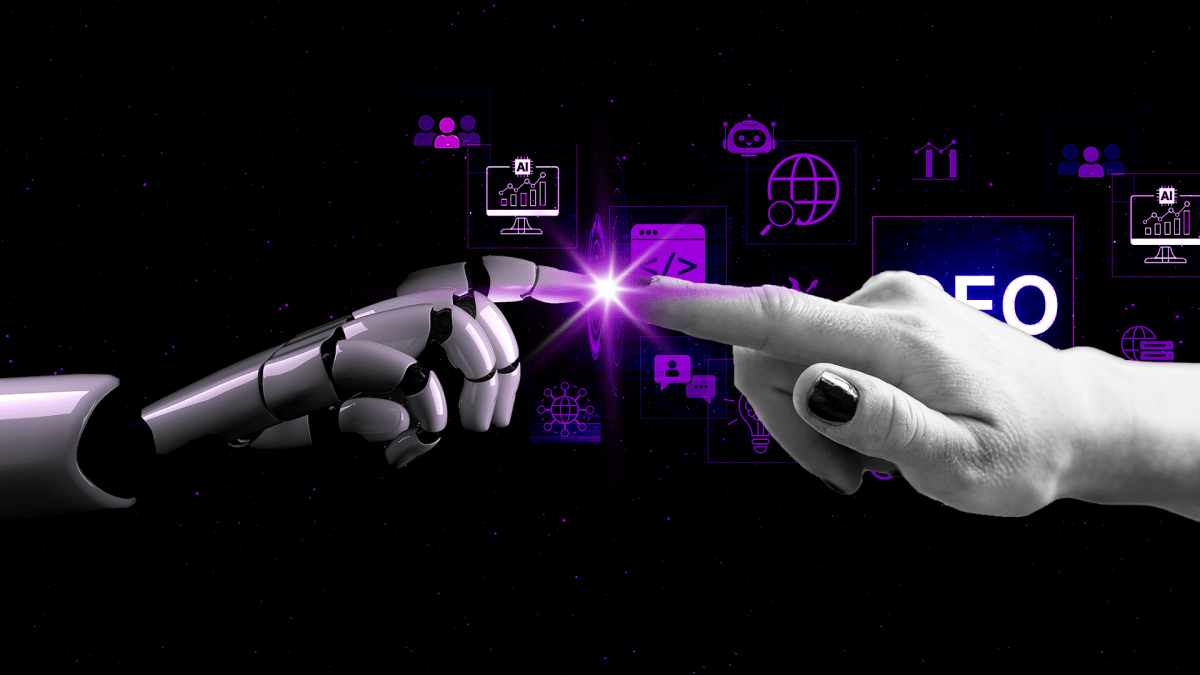
Not long ago, the ultimate goal of digital marketing was a first-page ranking on Google. Building backlinks, stuffing headings and content with keywords, trying to understand search intent, and staying on top of ever-changing algorithms were essential components of every digital marketing and SEO strategy, all in the hopes of climbing the rankings to the coveted first page spots.
While that era isn’t over, it’s starting to share the stage with something new: Generative Engine Optimisation (GEO).
If you’ve noticed that more and more of your searches are now answered on the page rather than through a list of links, you’ve already noticed the shift. AI Overviews, introduced by Google in 2024 and now known as AI Mode, use generative AI to summarise search results, answering user questions at a glace.
The inclusion of this feature is a clear indicator of this shift, and this shift means that the question is no longer “can people find your website?”
It’s become “is your brand part of the answer?”
In today’s blog post, Hyphen Creatives is breaking down what’s actually changing in the world of search. We’ll unpack what SEO is and why it still matters, introduce GEO, look at why the numbers suggest this shift is happening faster than most businesses realise, and share practical steps you can take to show up in both traditional and AI-generated search. So let’s get started.
What is SEO?
At its core, Search Engine Optimisation (SEO) is the practice of making your website more attractive to search engines, like Google and Bing, so when someone types in a relevant query, your content, website, and brand surfaces near the top of the results page. This involves everything from keyword research and on-page content structure, to backlinks, site speed, mobile responsiveness, and technical health.
Essentially, a user searches, a list of results appears, and they choose where to click. Your goal is to be the most compelling option on that list. Done well, SEO drives consistent, qualified traffic to your site over time, and it remains one of the most cost-effective long-term marketing investments brands can make.
What is GEO?
Generative Engine Optimisation (GEO) is the newer discipline that’s emerged alongside the rise of AI-powered search tools.
GEO is the process of optimising digital content to increase visibility and citations within AI-generated search results and answers from generative AI tools, including ChatGPT, Google’s AI Overviews, and other large language models. Where SEO earns you a place on a list, GEO earns you a place in the answer itself.
Unlike traditional SEO, which marketers use to help their content rank highly in traditional search engines, GEO guides brands to create content that generative AI tools will likely feature and cite in their responses. It’s less about being clicked and more about being trusted as a source.
What’s the Actual Difference?
SEO and GEO share DNA, but they’re after different outcomes. SEO optimises for clicks from a ranked list, while GEO optimises for citations inside a synthesised answer.
Where SEO is about capturing a single query and driving a click, GEO anticipates chained queries and answers them directly. Essentially, it’s about being the authoritative source behind a chatbot’s response, not just winning a position on the results page.
The Numbers Are Shifting Faster Than You Think
While it can be tempting to dismiss GEO as a future concern, the numbers and stats are showing that the shift is already happening at a rapid rate. AI-referred sessions jumped 527% year-over-year in the first five months of 2025, according to Previsible’s 2025 AI Traffic Report. Meanwhile, Gartner predicts that by 2028, up to 25% of searches will move to generative engines, and ChatGPT has already surpassed 400 million active weekly users.
Additionally, and perhaps more relevantly, 58% of users have already replaced traditional search engines with AI-driven tools for product and service discovery. While this may seem like niche behaviour, this figure is more than just an abstract statistic. It represents potential clients and users looking for exactly what your brand offers.
Despite the rise in GEO, SEO and Google isn’t going anywhere. In early 2025, Google saw over 14 billion searches per day, compared to ChatGPT’s 37 million, showing that SEO remains an important component in a brand’s marketing strategy. This means that the best move for brands is not to abandon one for the other, but rather to build for both.
What GEO Actually Asks of Your Content
GEO rewards the same things SEO does, and what has made content genuinely good all along: clarity, authority, and specificity.
Staying Real in a World of AI Answers
One vital thing to keep in mind is that GEO
Stay Ahead of the GEO Curve with Hyphen Creatives
Staying visible through the growing importance and relevance of GEO means having a brand voice that’s clear, content that’s structured to be cited, and a strategy that holds up across both traditional and AI-driven search.
Thanks for reading! Subscribe for free to receive new posts and support our work.